Группа кабеля Shenghua, профессиональный изготовитель по кабелю. Передать свет, соединить мир!
Cable colour code is a safety system, not a decoration, and it is one of the few specifications that a buyer can verify visually on the drum before installation. Wrong or faded core colours cause swapped neutrals, unprotected earths and phase sequence errors that are expensive to trace and dangerous to leave. This guide explains the harmonised IEC colour sequence for three, four and five core PVC cable, the numbered core system used on larger multicore cables, the North American conventions, and how colour is applied so that it survives heat, sunlight and time. It ends with six answers on earth conductor marking, phase colours, colour fastness testing and what to write in the purchase order.

A colour code assigns a fixed meaning to each core so that an electrician can identify phase, neutral and protective earth without test equipment. The harmonised European sequence, defined in IEC 60445 and its national derivatives, uses brown, black and grey for the three phases, blue for neutral and green-yellow for the protective conductor. A three core cable therefore carries brown, blue and green-yellow; a four core cable carries brown, black, grey and blue, usually with the earth provided separately or as a concentric conductor; a five core cable carries brown, black, grey, blue and green-yellow.
Above five cores, colour alone cannot identify every core, so the industry uses a numbered system: black cores printed with white numbers, plus one green-yellow earth core. Large multicore control and power cables therefore rely on printed numerals rather than on coloured compounds, and the print must remain legible for the life of the cable, which is a manufacturing quality issue rather than a design choice.
| Cores | Harmonised IEC sequence | Typical use |
|---|---|---|
| 1 | Brown, black, grey or blue | Single core in conduit or panel |
| 2 | Brown, blue | Single phase with neutral |
| 3 | Brown, blue, green-yellow | Single phase with earth |
| 4 | Brown, black, grey, blue | Three phase with neutral |
| 5 | Brown, black, grey, blue, green-yellow | Three phase with neutral and earth |
| Above 5 | Black cores with white numbers plus green-yellow | Control and multicore power |
Other regions differ. North American practice uses black, red and blue for phases, white or grey for neutral and green for earth, and equipment earthing conductors may be bare copper. Chinese practice follows a similar logic to the IEC sequence but with local variations in the phase colours for single phase circuits. A cable manufactured for one market and installed in another can therefore be internally correct and externally wrong, which is why the colour requirement must be stated explicitly in the purchase order.
A colour error rarely stops a project at delivery. It surfaces later, in a distribution board, during commissioning, or during maintenance years afterwards, and the cost is almost entirely labour.
1. Safety during maintenance. The clearest example is a borrowed neutral or a mis-identified phase. An electrician who isolates the wrong circuit because a core colour was inconsistent is exposed to a live conductor, and the fault may only appear on the next maintenance visit. Consistent colour is the cheapest safety feature in the building.
2. Phase sequence and rotation. Motors, pumps and lifts depend on correct phase rotation. If the cable cores are not identified as specified, the motor may run backwards on first start, which for a pump can mean mechanical damage and for a lift means a commissioning delay. Correct colour and correct terminal marking are what make the direction predictable.
3. Inspection and sign-off. Inspectors verify core colours against the specification and the local code. A cable that fails that check is rejected at the point where the building is almost complete, and the remedy may involve re-terminating boards rather than returning cable.
4. Colour fastness in service. A green-yellow earth core that fades to an indistinct pale yellow in a hot roof space is no longer identifiable, which converts a compliant installation into a non-compliant one over time. Colour quality is therefore a durability issue, not just an ordering detail.
5. LSZH and special compounds. Halogen free compounds are harder to pigment consistently than PVC, and some suppliers use a thinner surface tint rather than a fully pigmented compound. Under heat and UV the tint can shift, and a core that was brown at delivery may read as black after two summers in a roof void. Specifying colour fastness, not just the nominal colour, prevents this.
Write the colour sequence into the purchase order as a table, core by core, rather than relying on a designation. State the relevant standard for the market, the colour of each core, the earth core arrangement, the method of identification beyond five cores, and the jacket colour where it matters. Where a project spans several countries, state which national convention applies to each delivery, because a single sequence cannot satisfy all of them.
Ask for a colour sample or a short sample length for approval before production on large orders. A 300 mm offcut shows the actual pigment, the print quality on numbered cores and the jacket shade, and it can be compared against the project palette in a few seconds. Retain the approved sample with the order documentation, so that a later delivery can be compared objectively rather than by memory.
For quality assurance, request a colour fastness or heat ageing check on the core compounds where the installation is in a hot or exposed location. In practice, a short section held at elevated temperature for a defined period should show no significant shift when compared with the retained sample. This is a simple test and it exposes the thin surface tint that some low cost suppliers use.
At goods receipt, check three things: the core sequence against the order table, the legibility of printed numbers on multicore cables, and the continuity of the earth core colour for the entire length visible on the drum end. Then store the sample and the test record with the project file.
| Item to specify | Why it matters | How to verify |
|---|---|---|
| Core colour sequence | Safety and phase rotation | Visual check against order table |
| Earth core colour | Protective conductor identification | Full length, not sleeved ends |
| Numbered cores above 5 | Control circuit identification | Print legibility and durability |
| Jacket colour | Circuit or system coding | Sample approval |
| Colour fastness | Long term identification | Heat ageing comparison |
| Standard reference | Market compliance | Certificate clause |
Representative products include the coloured single wire PVC insulated cable rated 70 degrees Celsius, the white PVC insulated cable for household installations, and the customised colour LSZH cable from 1.5 to 800 mm2. Hospital and public building projects often use the coloured multicore LSZH cable for hospital buildings, and distribution boards prefer the BVR 1x4mm2 flexible PVC building wire in the specified phase colours. Where the whole cable is colour coded for a system, the red XLPE insulated cable for LV and MV systems illustrates how jacket colour is used for identification.
There are two ways to colour a core: pigment the whole PVC compound, or apply a thin surface layer or tint. Fully pigmented compound is more expensive but durable, because the colour extends through the insulation and cannot be abraded away at a terminal or a bend. Surface tinting is cheaper and looks identical at delivery, but it wears through where the cable is handled and fades faster under heat and UV. For cables installed in accessible areas, in hot roof spaces or in outdoor enclosures, the difference becomes visible within a few years.
Print quality matters equally on multicore cables. Numbers are printed onto black cores during extrusion, and a poorly controlled line produces print that smears, rubs off in the installer's hand or becomes unreadable after a season of thermal cycling. Ask for a print adhesion check and inspect a drum end for legibility: if the numbers can be rubbed off with a thumb at delivery, they will not survive twenty years in a duct.
Correct cable colour only delivers its benefit if the site follows the same discipline at termination. Three habits make the difference. First, terminate to the colour schedule and never to habit, because a board wired by memory produces exactly the inconsistent result the colour code exists to prevent. Second, label every cable at both ends with the circuit reference before the accessories go on, since colour identifies the core but not the circuit. Third, photograph the completed boards at handover: a colour photograph of the terminated board is the fastest reference available during a future fault or extension, and it costs nothing to take.
Where two conventions meet, for example an imported cable to an IEC colour sequence installed into equipment wired to North American conventions, resolve the difference at a terminal block with a documented transition rather than by re-colouring cores on site. Sleeving a core to change its identity is a shortcut that becomes a fault later, because the sleeve can slip and the underlying colour contradicts the joint.
Colour is often specified in isolation, yet it interacts with the rest of the cable design. A fully pigmented LSZH compound costs more than a PVC equivalent, because the filler system affects pigment dispersion. A custom jacket colour adds a minimum order quantity at most factories, so a small project should confirm the MOQ before committing to a non-standard shade. Multicolour or striped cores add cost and lead time at low volumes. Buyers who plan these details with the enquiry avoid a late change that delays the whole delivery.
A practical sequence is to fix the core colours from the standard, customise only the jacket if the project truly needs a system colour, and confirm the MOQ impact in writing. That keeps the safety benefit of standard core identification while limiting the commercial cost of customisation to the layer where it actually adds project value.
Finally, keep the approved colour sample in the project file with the delivery records. When a second batch arrives months later, or when a warranty claim is raised three years on, that retained offcut is the only objective evidence of what was agreed. It takes thirty centimetres of cable and a plastic bag to create, and it has settled more minor disputes than any certificate.
Green-yellow along the entire length, and it must not be used for any other purpose. Sleeving only the ends of a black core is not acceptable as an earth identification.
Brown, black and grey under the harmonised IEC sequence, with blue for neutral and green-yellow for the protective conductor.
By printed white numbers on black cores, plus one green-yellow earth core. The print must remain legible for the life of the cable.
No. North America uses black, red and blue for phases, white or grey for neutral and green for earth, so the market must be stated in the order.
Yes, especially in hot or sunlit locations and with thin surface tints on LSZH compounds. Colour fastness should be specified and tested for exposed installations.
If jacket colour is used for system identification, yes. Otherwise state it only if the project palette or the local code requires it.
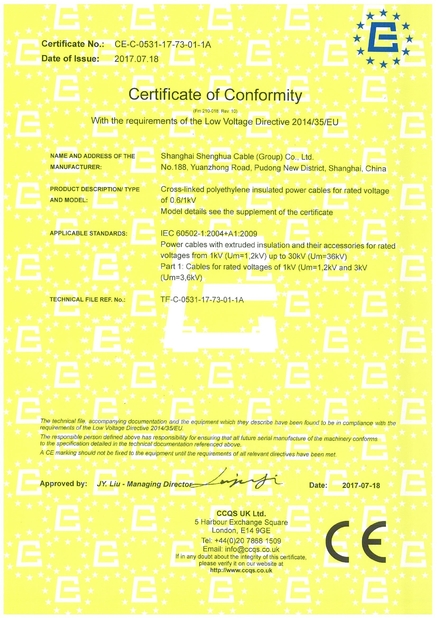
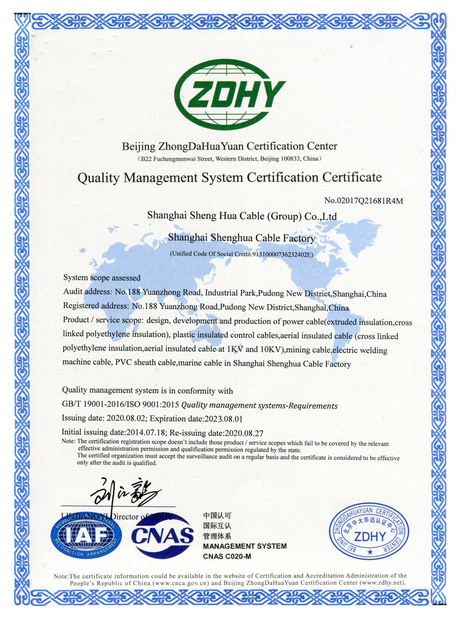
Cable colour code is the cheapest safety measure available and the easiest to get wrong, because it is invisible on a quotation and only visible on a drum. Specify the sequence core by core, approve a sample, check colour fastness for exposed installations, and verify on receipt. Those four steps prevent the swapped neutral, the reversed pump and the rejected installation that cost far more than any colour customisation. Shanghai Shenghua Cable Group manufactures PVC and LSZH cable in standard, numbered and custom colour sequences from 1.5 to 800 mm2, with retained samples and colour fastness data on request. Send your colour schedule and market standard through our contact page and our engineers will confirm the sequence, the print layout and the jacket colour before production.